
Winter work dressing fails in two opposite ways. Either the outfit is warm and reads as weekend — chunky knit, shapeless layers, boots that belong on a trail — or it is polished and completely unsuited to the commute, so the coat stays on through the first meeting and the whole look never lands.
The fix is the same one behind every good cold-weather outfit: warmth built into thin, hidden layers, and polish carried by structure on top. It is why the layering approach in our business casual outfits for fall guide still works in January — winter just asks for heavier fabrics and covered shoes, not a different system.
The Three Rules
Rule 1 — The base layer does the warming, the outfit does the looking: A thin thermal or a fitted long-sleeve under a knit adds real warmth with zero bulk. If you can see the warmth layer, it is not a base layer.
Rule 2 — Structure is what reads as professional in winter: A blazer, a tailored trouser, a coat with a clean shoulder. Soft pieces are fine underneath; something structured has to frame them. A well-styled blazer over a fine knit is the single most reliable winter office formula there is.
Rule 3 — Shoes decide whether it is a work outfit: The same trousers and knit read completely differently with a clean ankle boot or a loafer than with a chunky snow boot. Keep one pair of office shoes at your desk if the commute demands boots.
The 9 Formulas That Always Work
1. Fine Turtleneck + Wide-Leg Trousers + Blazer
The pieces: A fitted turtleneck, wool wide-leg trousers, a tailored blazer, ankle boots.
Warm at the neck, structured at the shoulder, clean at the hem. The default for client-facing days.
Why it works: the turtleneck replaces both a top and a scarf, so the neckline stays clean and warm, while the blazer restores the sharp shoulder line that knitwear softens. Keep the turtleneck fine-gauge — chunky knits bunch under a blazer and ruin the outline. If your office runs cold, add a thin thermal vest underneath; nobody will ever see it, and you will feel the difference by the second meeting.

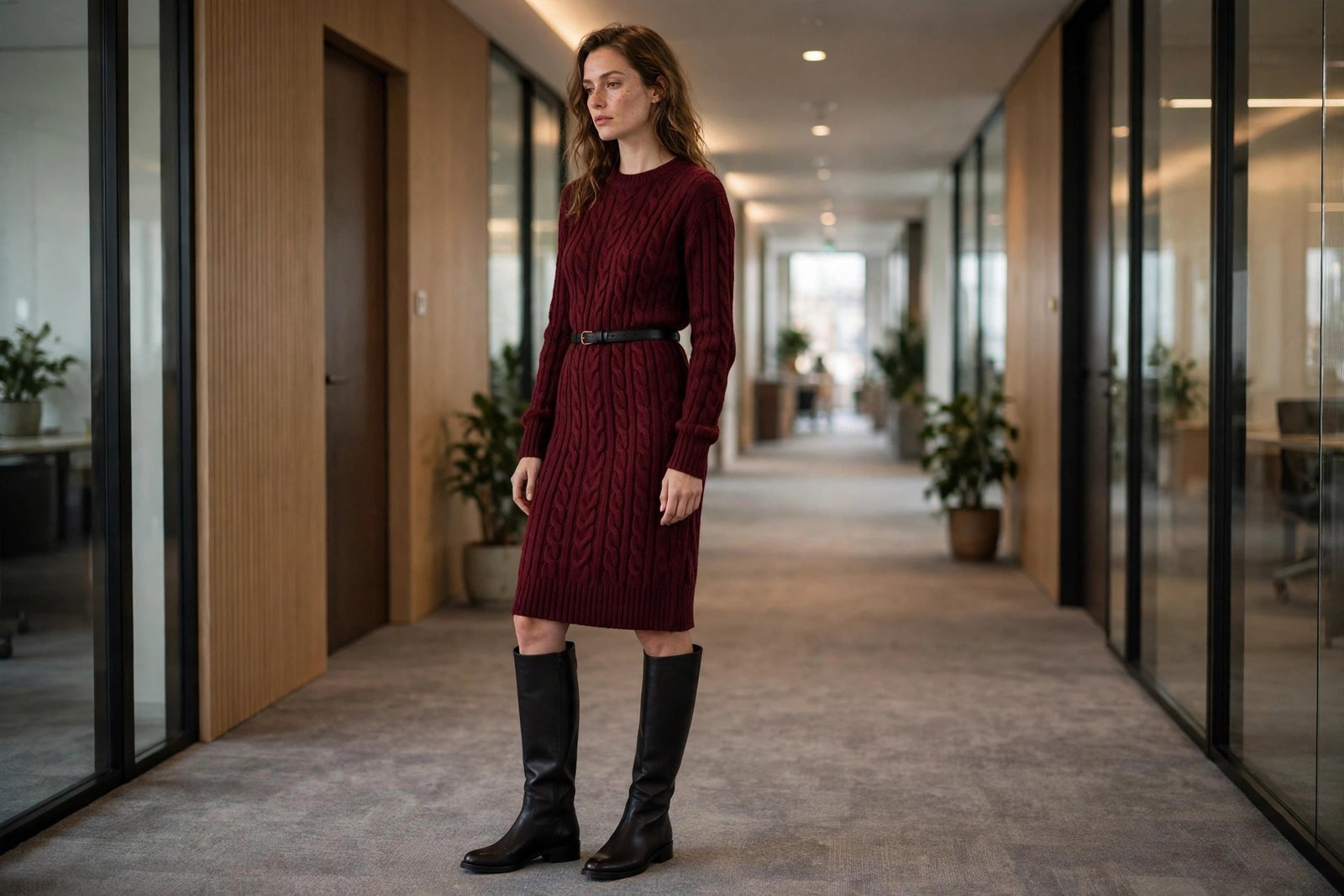
2. Sweater Dress + Tights + Belt
The pieces: A knit midi dress, fleece-lined tights, a belt, knee-high boots.
One piece, fully warm, and the belt is what keeps it in work territory instead of loungewear.
Why it works: a sweater dress is the fastest winter work outfit there is — one decision in the morning, no layering math. The two details that keep it office-appropriate are length and structure: midi, never above the knee, and a belt or a seam at the waist so the knit does not hang like a blanket. Fleece-lined tights are warmer than ordinary tights and jeans combined, and knee-high boots close the last cold gap at the calf.
3. Shirt Under a Knit + Tailored Trousers
The pieces: A collared shirt layered under a crewneck knit, straight tailored trousers, loafers.
The collar and cuffs peeking out do the polishing; the double layer does the warming.
Why it works: this is the formula offices have trusted for decades, and it earns that trust. The crisp collar against a soft knit reads instantly professional, and the shirt layer traps warmth against the body better than a thermal alone. Choose a shirt with a smooth finish — heavy oxford cloth can bulk up under a fine knit — and let a sliver of cuff show at the wrist. Loafers keep it grounded; on icy days, swap them for flat ankle boots and nothing about the outfit changes.
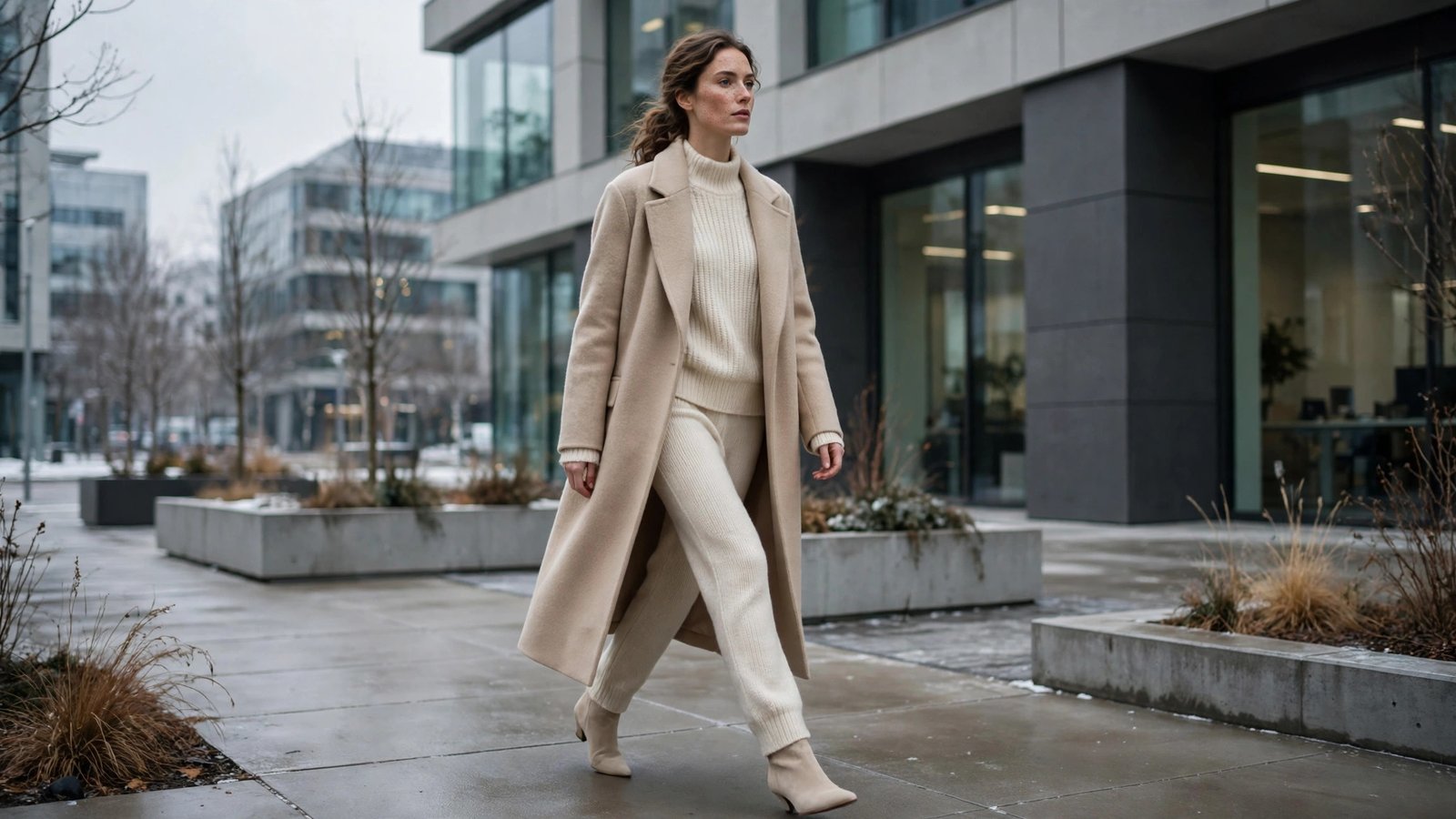
4. Monochrome Knit Suit
The pieces: A knit top and knit skirt or trousers in the same colour, long coat, pointed boots.
Matching knits read as intentional and expensive, and nothing is warmer per layer.
Why it works: a single colour from shoulder to hem stretches the silhouette and hides exactly where one piece ends and the next begins — which is why co-ord knits look expensive even when they are not. Cream, charcoal and chocolate are the safest office shades. Break the flatness with texture instead of colour: a ribbed top over a smooth skirt, or a fine knit under a brushed-wool coat. Pointed boots keep the softness from drifting into loungewear.
5. Dark Jeans Friday, Done Properly
The pieces: Dark straight jeans with no distressing, a fine knit, a blazer, heeled boots.
The blazer and the dark wash are non-negotiable — they are what separate this from a weekend outfit.
Why it works: Friday denim fails when any single piece leans casual, so every other piece has to lean the other way. Indigo or black denim with a clean hem reads almost like trousers; faded washes never do, no matter what you pair them with. A heeled boot — even a low block heel — lifts the whole look out of weekend territory. If your office is strict, this formula is not for you; if it allows denim at all, this is the version that survives a surprise meeting with a senior face.
6. Midi Skirt + Turtleneck + Tall Boots
The pieces: A wool or satin midi skirt, a slim turtleneck tucked in, knee-high boots.
The boots close the gap under the skirt, which is what makes a skirt honest in winter.
Why it works: most women abandon skirts from November to March because of one cold strip of leg — and the tall boot erases it completely. The boot shaft should meet or slip under the skirt hem; if there is a gap, wear fleece-lined tights in the same tone as the boot and the gap disappears visually. Wool skirts hold their shape in wind; satin skirts need a longer coat over them so the hem does not fight the coat lining all day.
7. Trouser Suit + Thin Thermal Base
The pieces: A matching trouser suit, a thin fitted thermal under the top, closed shoes.
For the coldest weeks: the suit keeps its line because the warmth is underneath it, not over it.
Why it works: this is the formula for the days when the forecast is serious but so is the meeting. A thermal with a deep scoop or V-neckline stays invisible under a blazer or a shell top, and modern heat-tech fabrics add the warmth of a jumper at a third of the thickness. Wool-blend suits insulate far better than polyester ones — check the label before the coldest weeks arrive, not during them. Keep a lint roller at your desk: winter fabrics shed onto dark suiting.
8. Cardigan as the Middle Layer
The pieces: A long cardigan over a fitted top, tailored trousers, a coat on top, ankle boots.
Three thin layers beat one thick one — you can shed the middle layer in an overheated office without losing the outfit.
Why it works: offices in winter swing between a freezing commute, a stuffy meeting room and a cold desk by the window — and this is the only formula built for all three. The cardigan is the adjustable layer: on for warmth, off or open when the heating wins. Length matters: the cardigan should end at or below the hip so it reads as a deliberate layer, not a shrug. Belt it over the top on the days you want it to count as part of the outfit rather than a spare layer.
9. All-Neutrals With One Rich Colour
The pieces: Neutral trousers and knit, one piece in burgundy, forest or chocolate — a scarf, a bag, or the knit itself.
Winter offices go grey fast. One deep colour keeps a practical outfit from reading as tired.
Why it works: deep winter colours do quiet strategic work here. Burgundy, forest and chocolate are as easy to pair as black — they sit happily next to grey, camel, navy and cream — but they catch light and attention in a way black no longer does by January. One piece only: the moment two coloured pieces compete, the outfit stops reading as considered and starts reading as accidental. A scarf is the lowest-commitment version; a burgundy knit is the one that gets remembered.
Three Mistakes to Stop Making
Mistake 1: The puffer over everything. A puffer over a blazer ruins both. If the commute needs the puffer, change at your desk — or wear a wool coat that is part of the outfit.
Mistake 2: One thick layer instead of three thin ones. A single chunky knit is warm outdoors and unbearable in a heated office. Thin layers adjust; bulk does not.
Mistake 3: Summer fabrics with a coat on top. A thin blouse under a heavy coat is still a thin blouse indoors. Winter work outfits have to work with the coat off.